NeurIPS 2026
Pinductor
Learning POMDP World Models from Observations with Language-Model Priors
Valentin Six, Frederik Panse, Mathis Fajeau, Lancelot Da Costa, Mridul Sharma, Alfonso Amayuelas, Tim Z. Xiao, David Hyland, Philipp Hennig, Bernhard Schölkopf
Abstract
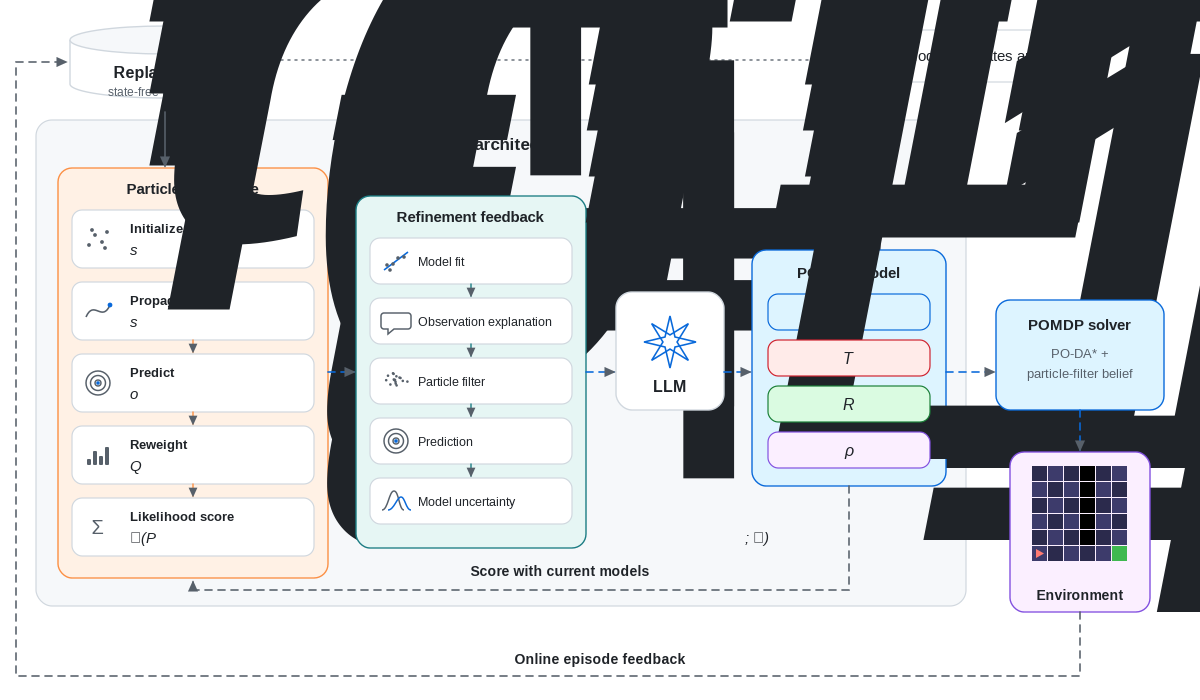
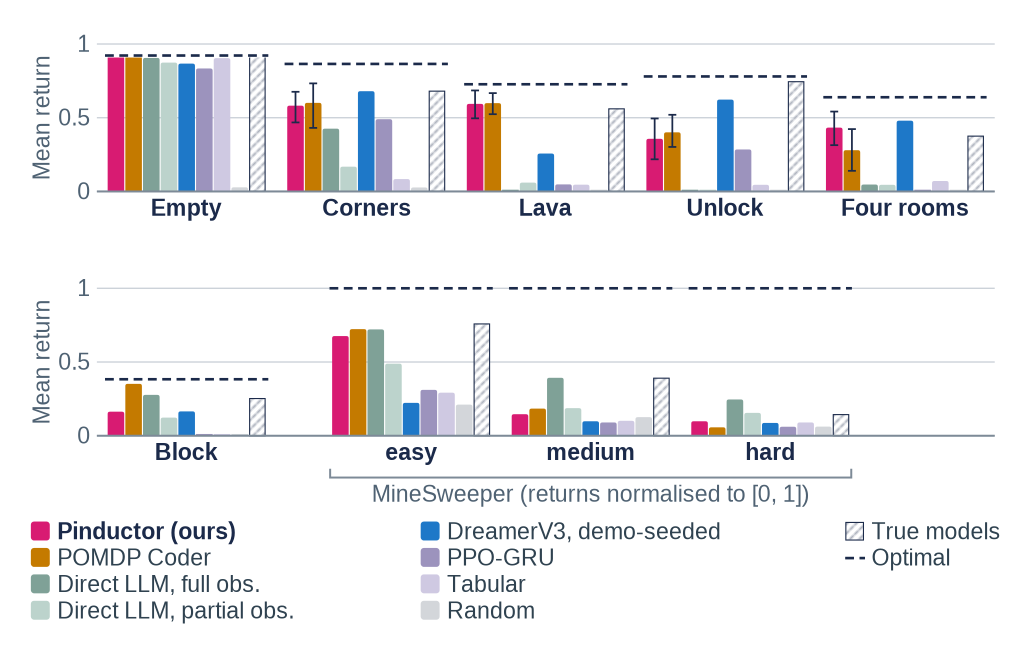
Whether navigating a building, operating a robot, or playing a game, an agent that acts effectively in an environment must first learn an internal model of how that environment works. Partially-observable Markov decision processes (POMDPs) provide a flexible modeling class for such internal world models, but learning them from observation-action trajectories alone is challenging and typically requires extensive environment interaction. We ask whether language-model priors can reduce costly interaction by leveraging prior knowledge, and introduce Pinductor (POMDP-inductor): an LLM proposes candidate POMDP models from a few observation-action trajectories and iteratively refines them to optimize a belief-based likelihood score. Despite relying on strictly less information, Pinductor achieves comparable performance and sample efficiency to LLM-based POMDP learning methods with privileged access to hidden states. Moreover, it is up to 330 times more sample-efficient than standard POMDP baselines such as DreamerV3, at comparable computational cost. Further results show that performance scales with LLM capability and degrades gracefully as semantic information about the environment is withheld. Together, these results position language-model priors as a practical tool for sample-efficient world-model learning under partial observability, and a step toward generalist agents in real-world environments.
- Model discovery
- Active Learning
- World Models